
Two lines can have the same syllable count and feel very different to sing. The placement of emphasis gives a phrase much of its movement.
Say it before you sing it
Read a lyric as if you were speaking to someone. Notice the syllables that naturally stand out. In a word such as “remember,” the middle syllable carries the main stress: re-MEM-ber. Across a sentence, meaning can change which words you emphasize.
Then sing the same words. If the melody puts a strong beat on a weak syllable, decide whether that tension sounds expressive or awkward. There is no requirement that every spoken accent land on a strong beat.
Choose the right accent guide
- In the studio, select your section and turn on an Accent guide.
- Choose Count if you want a number of strong accents without fixing their locations.
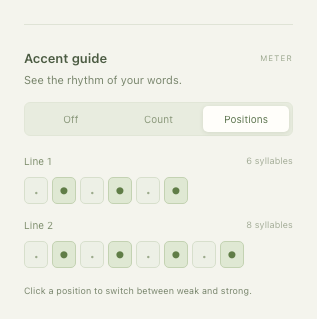
- Choose Positions if you want a particular strong/weak pattern. Click a position to change its target.
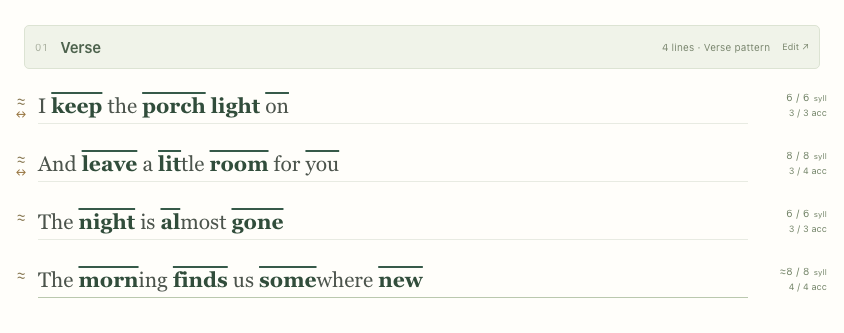
- Compare the guide with your lyric. Overlines mark target accent positions; bold syllables show the app’s estimated accents.
Use a small revision to test the phrase
Try saying “I kept the light on” with the emphasis first on I, then on light. The syllables stay the same, but the intention shifts. When a line feels forced, try changing the word order or moving a less important word away from a strong musical moment.
Treat automatic scansion as a reading aid
Kdenz distinguishes dictionary word stress from estimated sentence emphasis. It cannot hear your melody, infer every intended meaning, or predict a singer’s phrasing. Inspect alternative readings when a word looks wrong, and sing the line before deciding to revise it.